While writing an article about morality and ethics and discussing its principles with my coworkers, the topic of pornography was brought up. I sought out a book—such as the one shown above—as I wanted to learn more about the viewpoints of others and see if I was missing anything. This book was largely a waste of my time. The author explained his viewpoint through a series of drawn-out paragraphs that made sure to nail the same handful of points home as many times as possible. They spoke about a few different perspectives and rationales for the benefits, neutrality, or evils of pornography as well as the harm it may or may not cause to the users, participants, and / or society at large.
The anti-porn feminists (APFs) argue that porn is bad for women, makes the public perceive them as less valuable than men, makes women earn less money, and raises the amount of violent sexual crimes in a society.
The pro-porn feminists (PPFs) argue that it is empowering and important for the queers and helps women feel self-empowered.
The anti-porn, non-feminists (APNFs) argue for similar points to the APFs. They argue that women are harmed, porn is not covered by the First Amendment, and that it damages society at large.
The pro-porn, non-feminists (PPNFs) argue that porn is a "moral right" afforded to people (like the ability to drink alcohol) and that it may contribute to negative situations for women and society at large, it is protected as "free speech" and not harmful in itself.
What all of these perspectives seem to share is the assumption that pornography carries some built-in moral or social meaning, which I reject. After much consideration and reading a number of books in related fields, it seems to me that pornography is simply a form of communicative, artistic media in which the subject(s) of the media evoke a sexual response for a given audience, whether that media involves people, objects, situations, or purely symbolic themes.
This definition isn't perfect but it gets close enough for my tastes. The content of this media may be abhorrent and disgusting, revered as great art, or simply not that interesting to a given group of people. It all depends on the values of the society that is observing the material. I should also be clear that I do not mean "artistic" in the sense of artistic merit, but simply in the sense that the material is creatively produced, as all photography and videography is. Furthermore, in the same way that photography has no inherent value to someone who cannot see it (such as the blind), the value of pornographic material exists exclusively in the relationship between the work and the observer, not in the work itself. Sure, this means that "anything can be pornography" and "nothing is pornography in itself". I agree with these statements, although they sound absurd. The society I live in classifies pornography in a way that is different than another society, no matter how similar or distinct those differences are. This inherently means that some items I would find to be pornographic in nature aren't seen as such by everyone else on the planet.
Because of this, I found very little of value in a book that treats pornography as if it must be either a social toxin or a social good. To me, that entire debate is built on assumptions I do not share, so the arguments themselves never really get off the ground. If others find meaning, harm, empowerment, or identity in this kind of media, that is their business, but I see no reason to treat those reactions as properties of the material itself. For that reason, this book did not challenge my views so much as confirm that most discussions about pornography are really discussions about people's values, not about the media they are supposedly analyzing.
Lastly, I personally believe that the vast majority of pornography facilitates a negative impact on society by promoting miscegenation, funneling more money into the hands of the (((people))) that produce this content en masse, and in degrading the potential for healthy family relationships between men and women. I waited until the end to share my beliefs as I think it is wise for others to consider how they think about all aspects of life before they decide what they think.
Dual-System Moral Realism (DSMR) is a normative framework that distinguishes sharply between morality and ethics, treating morality as a descriptive account of violations of bodily or property integrity and the agency responsible for them, and ethics as a socially constructed system of judgment, permissibility, and response. Under this view, all events involving persons or property are morally describable with respect to responsibility, but only ethical systems determine whether such events are justified, excused, or condemned.
The framework maintains that moral facts about integrity violation and responsibility exist independently of social approval, while ethical permission is determined by communal norms, institutions, and practical priorities. Justification does not erase moral violation; it only governs how societies respond to it.
Dual-System Moral Realism is structured around five central claims:
Morality is descriptive, not prescriptive.
Morality does not instruct agents on what they should do. Instead, it describes what has occurred in terms of integrity violation, agency, and responsibility.
Moral attribution depends on agency.
Events are morally attributable only when violations of bodily or property integrity occur through the (in)action of agents with the capacity to choose otherwise.
Ethics governs judgment and permissibility.
Whether an action is treated as acceptable, excusable, or punishable is determined by ethical systems adopted by societies.
Justification is social, not moral.
Actions are not rendered morally innocent by necessity, benefit, or good intentions; they are tolerated or excused because ethical systems prioritize certain outcomes or social goals over strict non-violation.
Prevention is ethically preferable to justification.
Avoiding integrity violations entirely is ethically superior to permitting violations and later excusing them, since prevention avoids moral violation altogether.
Within this framework, morality concerns two components:
Integrity violation: Interference with, alteration of, or destruction of a person's body, autonomy, or property.
Agency: Whether the individuals involved had the capacity to choose and act otherwise.
Morality does not evaluate whether violations were beneficial, reasonable, or socially useful. It records only whether bodily or property integrity was violated and whether that violation is attributable to responsible agents.
Because morality is descriptive, it applies universally and continuously. Every instance of interference with bodily or property integrity is morally relevant in the sense that it can be examined for responsibility, even when socially accepted or legally mandated. The decisive moral distinction is whether such interference is attributable to an agent.
When integrity is violated through the (in)action of a responsible agent, the event is morally attributable. When violation occurs without such agency—through natural events, accidents, or physical incapacity—the outcome may be tragic, but it is unmoral, in the sense that no moral responsibility applies.
Examples include:
A person killing another person → integrity violation with agency (morally attributable).
A person refusing to help when capable → integrity violation with agency (morally attributable).
A tree falling in a storm and damaging a house → integrity violation without agency (unmoral).
A person in a coma failing to aid someone nearby → integrity violation without agency (unmoral).
Unauthorized alteration of another's property, even if beneficial → integrity violation with agency (morally attributable).
Ethics refers to systems of social evaluation that determine:
whether an action is permitted,
whether it is excusable,
whether it deserves punishment,
and what responses are appropriate after integrity violations occur.
Ethical systems vary by culture, legal structure, tradition, and historical context. Events involving the same moral facts may be judged differently by different societies.
For example, killing in self-defense may be ethically excused or even praised in many societies, while still constituting a morally attributable violation of bodily integrity. Ethical permission reflects social priorities such as survival, deterrence, and stability, rather than changes in the descriptive moral nature of the act itself.
Moral responsibility depends on agency. Where meaningful choice is absent, moral blame does not apply even if integrity is violated.
Common examples include:
individuals in comas,
persons experiencing sudden medical incapacitation,
cases of physical coercion that eliminate alternatives.
In such cases, destructive or intrusive outcomes may still be real, but responsibility is absent. These situations are treated as misfortune rather than wrongdoing. This distinction prevents moral evaluation from collapsing into pure outcome-based judgment and preserves the role of choice in assigning responsibility.
Under Dual-System Moral Realism, institutions such as:
courts,
governments,
medical systems,
and community norms
function as ethical authorities, not moral arbiters. They regulate how societies respond to morally attributable integrity violations, including when such violations are:
punished,
tolerated,
or institutionally authorized.
Actions such as imprisonment, property seizure, medical procedures without consent, or lethal force may be ethically sanctioned while still constituting morally attributable violations of bodily or property integrity. Ethical legitimacy does not alter the descriptive moral status of the acts themselves; it only establishes social permission and procedural justification.
The framework recognizes that some situations create unavoidable moral loss, where every available option involves integrity violation attributable to agency. In such cases:
ethical reasoning selects the least socially unacceptable option,
but no option is morally cost-free.
This produces what is often termed moral remainder: a persistent recognition that violation has occurred even when ethically justified. Ethical permission manages conflict but does not retroactively convert violation into moral good.
Unlike deontological theories, DSMR does not treat moral rules as commands governing behavior. Morality does not prohibit actions; it describes responsibility for violations after the fact.
Unlike utilitarian theories, violations do not become morally neutral when outweighed by benefits. Ethical justification may permit violation, but moral attribution remains.
Unlike relativist theories, moral facts about integrity violation and agency are not dependent on cultural agreement. What varies is ethical response, not moral responsibility.
morality describes violations of bodily or property integrity and agency without prescribing conduct,
ethics determines permissibility and social response,
responsibility requires agency,
justification does not erase moral attribution,
and prevention is ethically preferable to post-hoc excuse.
The framework aims to preserve objective moral seriousness while acknowledging that societies must still govern tragic and unavoidable conflicts in practical ways.
These questions were submitted to me and I have written my answers below each.
Q #1: You are a surgeon with five patients who will die today without organ transplants. A healthy person is in your care whose organs could save all five, but they will die if you take them. You can sacrifice this person and no one will ever know what you did. Do you take the organs to save the five, or do you refuse and allow the five to die?
A #1: I would obviously not sacrifice the healthy person to save the five as it violates the bodily integrity and ownership rights of the healthy person (their body and life). Furthermore, I personally believe that organ transplanting is a form of corpse desecration much like cannibalism and I am against it.
Q #2: You are a firefighter in a burning building. There is a single child trapped in a room and two adults trapped in another room, you can save the occupants of either room, but not both. Whom do you save, and why?
A #2: This particular situation will result in a tragedy either way you decide to approach it. If the three individuals are unrelated, it may lessen the grief of the surviving party/-ies, but it is still a weighty decision. Do I rescue the presumed parents and guarantee their grief of losing their child or do I rescue the child as they have a greater potential for a long life than the two adults? I would probably opt to rescue the child as they have that potential as I stated earlier, they have less ability to escape on their own, and they are less responsible for their situation than the adults in the house are.
Q #3: You are in a lifeboat that can safely hold six people. Seven survivors are trying to climb in. If all stay, the boat will sink and everyone will die. What, if anything, should be done? How should survival be decided, if at all?
A #3: Again, this situation guarantees a tragic outcome for someone. If I felt that my life was the least valuable among the participants, I could envision self-sacrifice, but this would have to be extremely obvious to make that decision in short order. I believe the occupants would put it to a vote and forcefully expel the seventh person if need be. I don't believe this is fair or a good outcome, but it is bad by necessity due to the circumstances. The term moral remainder applies here.
Q #4: Someone is hiding in your home from a person who intends to kill them. The pursuer comes to your door and asks you directly whether the person is inside. Do you lie to protect the person, or tell the truth? Are you responsible for what follows either way?
A #4: Firstly, I am not ethically culpable for the attacker's actions. Furthermore, from the way the question is worded, I assume that the sanctity of my property was violated by the intruder in order to gain access and hide. I also don't owe the truth to a stranger, especially if he is on my property without permission. I would probably lie to the pursuer unless I had reason to believe doing so would place me in immediate danger.
Q #5: You are in control of a vehicle that is about to crash. You can stay on course and hit five pedestrians, or swerve and hit one pedestrian instead. Do you intervene to change the outcome, or do you refrain from acting? Does action differ morally from inaction here?
A #5: I don't have enough information about whether I had control before this moment to know if the "control" I have over this vehicle existed before this dangerous situation became unavoidable. Assuming it did and I am fully responsible for the upcoming death(s), then I would swerve to hit the single individual. The total misery created by one vehicular death is probably less than if I had hit five people, either way, it's my fault. Assuming I was not in control of the vehicle until the moment before the crash (say I seized control of a runaway vehicle), then the outcome is another moral remainder situation. Again, I would swerve to hit the single person, but at least I wouldn't be as culpable in this case.
Q #6: You discover that your employer is hiding a defect that will likely harm customers in the future. Reporting it will stop the harm but will also cost many coworkers their jobs and violate your contractual obligations. Do you report the problem or stay silent? Which obligations take priority, and why?
A #6: The correct action is to report the employer’s actions to the relevant authorities, because preventing foreseeable violations of bodily or property integrity takes priority over contractual and financial consequences. Even if I knew the repercussions would be dire for myself, I would still report the employer.
Q #7: You are responsible for setting a policy that will heavily tax a small, wealthy group to fund programs that will dramatically improve the lives of many poor citizens, though not necessarily save lives immediately. Is it morally acceptable to impose this burden on some to benefit many others?
A #7: No, taxation is theft. If the wealthy wanted to donate money to these people, then that is fine, but strong-arming them into doing it is wrong. Poor people are often able, but often not willing, to help themselves out of whatever poverty they are facing.
Q #8: You are on your way to an event that is extremely important to someone you love, and you promised you would be there. On the way, you encounter a stranger in urgent need of help, and no one else is around. Do you stop to help, breaking your promise, or continue on?
A #8: If my inaction foreseeably allows bodily harm I could prevent, then I would do my best to help the person. Missing a recital or dinner doesn't violate anyone's body, property, or autonomy. While the specific task that I am helping them with will have to be rather dire, I will assume that it is life-and-death for the sake of my answer. Someone changing a blown-out tire? Probably not. Someone yelling for help? Probably so. A reasonable person would absolutely understand that some matters can't be predicted and take precedence.
Q #9: You are in a position of authority over a community that practices a traditional ritual which causes serious harm to participants, but the community strongly values it and sees interference as cultural oppression. Do you allow the practice to continue, or do you intervene to stop it?
A #9: This question says the ritual "harms" the participants, but that the practice is highly valued by the society (and therefore, its participants). So where is the harm judgment coming from? I may believe the practice is harmful, but that judgment reflects my ethical values, not a moral authority to override consent. While I can work to change social acceptance of the ritual, I cannot ethically justify violating participants' bodily autonomy to prevent it.
Q #10: You can save someone's life by making a permanent personal sacrifice that will significantly reduce your own quality of life, but you did not cause their situation and are not obligated by law to help. Are you required to make the sacrifice, permitted to refuse, or are your actions praiseworthy only if you choose to help?
A #10: This is a question about personal preference. Since the sacrifice would be voluntary on my part, then it comes down to the specifics of the situation. If I could donate a kidney to save my innocent child's life, then I would consider it, even though I am personally against organ donation (for instance). The potential benefits seem to outweigh the potential losses in that particular scenario. If it's a stranger? Hell no, they're on their own. I'm not morally responsible for the situation, and ethics may praise sacrifice but cannot require it, absent prior responsibility.
Note: I want your questions! If you would like me to answer your morality / ethics conundrums, then please send them my way via email—blog (a) newsaint.org—or Telegram. I'll add them to this article if they're interesting
One thing I've always appreciated about social media is the block functionality. I don't like to have private accounts or channels or whatever, I like to have my stuff free and open for anybody to look at. But, whenever someone comes across my path that I find annoying or ugly or just bothersome, I block them and then poof they're gone and I don't have to see them and my ramblings won't grace their eyes again.
Someone posting stuff I don't agree with?
Blocked.
Someone being annoying?
Blocked.
Some "protected class" whinging about something or other?
Blocked.
Someone virtue signaling about some bullshit that they are parroting?
Buh-buh-blocked!
I dislike anonymous / internet arguing as it leads nowhere and doesn't change anyone's minds. People—en masse—are too stubborn for discussion online and with the rampant use of irony, how can you tell if someone is being serious or not? I prefer to just erase them from my sight. I don't like to argue or leave negative comments or engage in any way. I just block them.
On the flip side, I am blocked from commenting in like a dozen Telegram channels for previous anti-(((Abrahamic-religion))) comments. That's the price I pay and I don't really mind.
Also, every platform that has a like button should have a dislike button. Unlike those Meta platforms, YouTube, and the like, we need a way to show our disapproval without going into the comments. Reddit almost has it right, but the vote system still focuses on the positive interactions most of the time. Interestingly, Itch.io got this right and has a visible like and dislike counter for their comments section.
Lots of content creators hinder their audience's ability to inter-/react with the posted content by disabling comments, hiding likes, or otherwise limiting engagement, usually when the general opinion on the posted material is negative. That's why I leave the negative emojis enabled on my Telegram channel. I'm not afraid of that guy that vomit reacts to my homemade meatballs or my desire to make videogames in my free time.
Perhaps my approval of blocking and my disapproval of a creator restricting responses is a double-standard. I could see that argument, but I don't care!
The engine sighed with relief as the man shifted into park. It was an older model—they all were—but it started when needed and it handled well-enough on the unkempt streets leading to the city outskirts. With the engine off, the cold began to set in and the man gathered his pack, keys, and ID badge.
The thud of the car door echoed quickly off the walls of the parking garage. Even though there were no other vehicles in sight, he always parked at the rear of the lot. I suppose he enjoyed the brisk walk to the tram that would take him into the city. The car ride was only a few minutes, but the tram took at least twenty. The man didn't mind however, he liked to look out from the cabin hanging high above the withered city and silently wonder what it must have looked like in its prime.
The tram reached the next station, steadied itself, and slid its doors open. A mechanical voice calmly identified the next station and the estimated arrival time as the vessel shuddered and picked up speed. The man didn't bother to look around as he was always the only person onboard, this time was no different.
Through frosted windows the man could see his destination. A massive, chiefly concrete structure that spanned multiple blocks and sat squarely in the center of the city. No windows, lights, or life could be seen. Just some water vapor from a few scattered vents on the roof.
***
The doors opened, the man exited, and the tram retracted itself from the building's station and continued its lonely itinerary. In a few seconds, the man covered the length of what was called "The Gate". It was a small cutout on the corner of the enormous building with metal shutters that opened and closed when a tram approached, but otherwise sat idle, just filtering the dim morning light onto the polished concrete floor. Faded yellow lines used to usher employees to the correct entrance, or to the guard station if they were a visitor.
That station was little more than a small room with a square window, a thin slot for handling paperwork, and a narrow door, all tucked into the wall next to one of the entrances. The man assumed the door was locked, although he never actually bothered to check. Through the dark window he could, however, see a desk, two chairs, a camera monitor, and a pile of visitor badges. The black anti-fatigue mat sits a few feet from the door, slightly chewed by rodents and faded by the checkered sunlight that fills this small landing in the evening.
The man tapped his ID badge to the black square on the wall, a little red light turned green, and his entrance opened with a burst of slightly-warmer air. Dim yellow lights lined the hallway but turned a brilliant white as he passed beneath them. The man walked his usual route to his post and he felt the darkness creep behind him as the lights dimmed once more.
***
The man's job wasn't complicated, but it did require a fair amount of skill and a keen eye. He had never met his employer and didn't seem to have any coworkers. The man received an offer through a blank envelope slipped under his door just hours after reporting his recent furlough to the local employment office. He was expecting notice of a job opening of some kind, but these communications are typically delivered via phone or electronic mail.
The envelope contained a single piece of stationary listing an address, tram number, a date, a list of duties, and a more-than-reasonable salary. The man only had the weekend to contemplate the offer. Monday came, he followed the directions to the tram, then to "The Gate", then to his office. That was years ago now.
Through his scrupulous saving and frugal living, the man was able to afford a slightly nicer apartment a few minutes closer to the tram station after only a few months‘ work. This afforded him the rare luxury of getting home a little earlier and sleeping in a little later. He felt this extra time was well spent.
***
The man approached his office door and once-again tapped his ID to the black square next to the door. After the short beep and familiar click the man heard from within the wall, the door was unlocked and he made his way inside the dark room.
A sensor picked up his presence and the lights rose to full power over a few seconds. The man placed his pack in a locker, trading it for a plastic suit that covered him head-to-toe, a full-faced respirator, and an exposure monitor. Now within his expected dress-code, the man approached his station and began to draw a pale red liquid from one of a dozen taps along the rearmost wall.
Once a sample has been collected, it is analyzed for contaminants and clarity. Light red was the desired hue, free from any inconsistencies or impurities. The man held the vial up to a bright inspection light, rotating it slowly. Satisfied, he placed the sample in a small pneumatic tube, pressing a button to send it off into the depths of the facility, or perhaps even further.
The rest of his shift continued in much the same way. Tap, fill, inspect, send. Occasionally, his exposure monitor would beep, indicating a stray particle had reached unsafe levels, but the air filtration system would quickly whir to life, clearing the contamination before it could pose any real danger.
He had long since stopped wondering where the liquid came from or where it was going. Early on, curiosity had gnawed at him—what exactly was his role in this grand machine? The closest thing to an answer had been the day he found a scrap of paper wedged into a vent near his station. On it, a few smudged words stood out: "Keep the balance."
At first, he thought it might have been a note from a previous worker, but the paper was too clean, the ink too fresh. He had looked around then, half expecting someone to be watching from the dim corners of the facility. But, as always, he was alone.
The end of his shift came as it always did—with a sharp, mechanical chime. The man returned his equipment, checked his exposure levels, and left his office. The hallway remained as empty and silent as when he arrived. His footsteps echoed softly against the smooth floor, the lights brightening only long enough to escort him out.
When he reached "The Gate", he hesitated. Outside, the night had fully settled over the city, casting long, cold shadows between the skeletal remains of old buildings. The tram station sat empty, waiting for its single passenger.
Something felt different tonight.
He turned his head slightly, his breath catching in his throat. For the first time in years, there was another set of footprints in the dust outside the guard station. Fresh, distinct.
And they weren't his.
This is a short story that I wrote over two separate days: 2024-08-28 and 2025-03-10. If you enjoyed this, the PDF version is available here.
Author's Note: This is a short rant written in 2022 in response to an argument I had about the best method for keeping records of time. I have lightly adapted it for this format and made minor changes where appropriate.
For those in the US, you're probably used to the MDY (Month, Day, Year) date format, along with using a 12-hour clock. This system is bad and is rife with confusion. Most other systems are even worse (I'm lookin' at you DMY).
If we're gonna make it to the glorious techno-future then we're gonna need to get on the same track about dates and times... but if we're destined for nuclear hellfire / apocalypse, then I guess this rant won't matter.
Anyway, the only useful and correct date / time format is Year > Month > Day > Hour > Minute > Second. Big to small. Old to new.
In a computer system—or even a paper-based system—this format will sort files in perfect chronological order. Let's take a look at an example.
You have three files that need to be sorted and three methods to do so:
This system has the files in order by the day of their respective month. The day in which something occur is almost always less important than the chronology of its occurrence in relation to other events. This system is bad.
This system has the same issue as the previous method. The month in which something occurs is helpful, but the October of one year is very different than the October twenty years hence. This system is bad.
This system solves the chronology issues of the above two methods. Dates are grouped with those that are closest together in time and go from the past, to the present, to the future.
1999-12-31.txt
2013-03-04.txt
2019-08-11.txt
2024 Update: I was well aware of the International Organization for Standardization by this point, but didn't bother to look into their suggestions for time keeping. Turns out ISO 8601 covers the above completely and should be adopted worldwide galaxywide immediately. If you're curious, another resource you can reference is Wikipedia's list of date formats by country.
2025 Update: Furthermore, I suggest completely abolishing the concept of time-zones. The date and time should be the exact same all over the universe. "But what about business hours or my alarm clock??? WhO wAnTs To Go SeE a MaTinEe At 22:00 UTC??" Those remarks could only be writted by the utterly deranged and altering the concept of time to fit a human store's business hours—not to mention someone's personal schedule—is an absolutely insane thing to suggest. ALSO, how the hell us Coordinated Universal Time abbreviated to UTC? ALSO ALSO, DAYLIGHT SAVINGS TIME.
I use a gamepad when I play PC games, at least in the majority of 1st Person games. Between annoying keyboard layouts, a decade of console gaming before I ever built a PC, and sheer laziness, I find it to be the easiest and most comfortable way to play most games.
My first few years of playing games were spent primarily on the PS2 and PS3. They were okay consoles with a good library of games, but a ton of technical problems that I won't get into here. However, one thing I absolutely hated about both consoles were the controllers.
DualShock 3 controller
The DualShock 3 was uncomfortable, cheap feeling, and basically unusable on a PC. The layout of the controller was awful, it was too small, and the shape wasn't ergonomic, but the DS3 had one redeeming feature that I'll mention below.
Later, I would buy a used Xbox 360 from a pawn shop. The controller was quite different from a DS3, but light years better. It felt alright in the hand, buttons made more sense, had a good feeling of weight and solidity to it, an all around 6/10. AA batteries, a weird proprietary data cable, and shit windows support kept it from going into regular use in my setup.
DualShock 4 controller
When November 2013 rolled around, I ended up buying a PS4 a few weeks before Christmas, which entered a new contender in the ring: Sony's DualShock 4. This controller was much, much better than the DS3. It was solid, felt great, had a fun light bar, a rechargeable internal battery, and wasn't using a proprietary connector. BUT, four major flaws put this controller in the garbage where it rightfully belongs;
A stupid button / stick layout
That retarded touch bar that ate up 20% of the controller face
Almost nonexistent Windows support
God-damned Micro-USB
Last-generation's DS3 controller had a sharp advantage over the DS4 however: Mini-USB. This connector is older, but far better than Micro-USB for one reason, it (almost) never wore out. Mini-USB cables are just as useful in 2006 as they are in 2022, they just keep going.
I can't even begin to express my utter and unquenchable hatred of Micro-USB. It's insane how much disdain and loathing I have for such a small, shitty USB interface. Micro-USB male connectors use a small, mechanical clip mechanism to hold the connector in place. This serves to secure the cable when inserted into a controller, cellphone, etc. This is good in theory (think DisplayPort, which I also hate), but in practice this "feature" introduces an artificial lifespan to any given cable. These clips wore out so fast your head would spin, especially with repeated connect / disconnect cycles (i.e. with a phone or some sort of peripheral device).
DS4 controllers also suffered from a few design flaws beyond the ones mentioned above. For instance, the left thumbstick and accompanying button (L3) would wear out fairly quickly with the stick easily losing the ability to track forward movement, especially within the Call of Duty game franchise. I've had L-Stick problems on every DS4 controller that I've played CoD on and I'm not heavy handed or hard on my controllers.
Xbox One controller
Alongside the PS4, came the Xbox One as well. With it came a new controller and Microsoft actually did some good work this time. The controller was solid, comfy, had a halfway-decent button layout, a standardized connector, and good Windows support. Only a few problems still remained;
AA batteries (again)
Offset thumbsticks (again)
Micro-USB (again)
I settled on an Xbox One controller and went about my life for a number of years. MS eventually replaced the original, chunky controller with a sleeker and all-around better model a few years later with the release of the Xbox One S. Later still, the Xbox Core controllers entered the market, this time packing the much more acceptable USB Type-C connector. Finally, some good features. I grabbed a Blue core controller for $65 (yikes) and a rechargeable battery pack and lived happily ever after.
Until about a year into the controller's lifespan when my thumbsticks started drifting. Both DS and Xbox controllers suffer from pervasive thumbstick problems. They're easily the largest weak point on a game controller. They're incredibly prone to wear, misalignment, dead-zones, sticking, ghosting, drifting, and a million other verbs that I can't remember. The design of thumbsticks for both brands are largely the same; a left / right potentiometer and a button, simple. Problem is, they're finicky and fragile.
This wouldn't be an issue if the thumbsticks were user replaceable though: pop open the controller, fish out both sticks, put in some new ones, and you're off to the races or battle or whatever (kinda like how some Cherry MX switches are swappable). This isn't the case however. There are fourteen (!) solder points for each of these thumbsticks and for someone like myself who isn't the best solderer, this proves troublesome to remedy myself. Furthermore, replacement potentiometers need to be live-aligned, which is a tedious and frustrating task in itself. That mechanism I mentioned was also designed so poorly as to never really read as centered. Apparently, the controllers just sort of tare the factory alignment so you never notice a difference. That is, until the original thumbsticks wear and you go to replace them yourself.
With all of that out of the way, here is the core position I hold in this discussion. Controllers need to be fixed, and luckily there are really only a few fixes that need to be made.
Firstly, the layout. Gamepads have sort-of landed on a set layout (except for Sony), this layout consists of two thumbsticks (+ L3 / R3), four face buttons (A, B, X, Y), L / R bumpers and triggers, a D-Pad, Start, Select, and a Home button. I excluded Sony because they seem to be straying from this standard with the DS4 and DS5 controllers' notable lack of Start, Select, (trading them for Options and Share for some dumb reason) and the inclusion of that useless touchpad.
This layout is typically accomplished with the face buttons, D-Pad, and thumbsticks sharing real estate on the front of a controller, with the bumpers and triggers on the back or top (depending on your perspective). PlayStation accomplishes this with both thumbsticks on the lower plane, while the D-Pad and face buttons share the upper plane. Sony almost has it right with this layout, but not quite. Microsoft has the left thumbstick and face buttons on the top plane, with the D-Pad and right thumbstick on the lower. Again, this is close, but not optimal. There is actually only one controller that I know of with their thumbsticks and buttons in a sane and ergonomic position: The Nintendo Wii U Pro controller.
Wii U Pro controller
This unlikely candidate does the incredible, it actually has the D-Pad, face buttons, and thumbsticks in the correct orientation. At rest, the human thumb is in line with the bones of the forearm. This means, at rest, the thumb wants to sit over the top plane of a gamepad. Sony controllers have both thumbsticks on the lower plain, meaning you have to strain your thumbs down to interface with those sticks. While Microsoft has it half-right with just the left thumbstick in this position, the right thumb still needs to be bent to utilize the right thumbstick.
Gulikit Zen Pro controller
Update 1: Since writing the above section, Gulikit, a 3rd Party, Chinese controller manufacturer has become popular among those of us who share the above gripes about carbon potentiometers in game controllers. Their new design retains much of the old thumbstick design, but with electromagnetic potentiometers that should last significantly longer and retain their calibration to a much tighter tolerance. I just purchased one of their Zen Pro controllers ($50 on eBay) and one of their wireless controller adapters. I'll probably also 3D print some trigger stops for it as I have become accustomed to using them on my Xbox Elite Series 2 controller that I bought broken – which I then repaired – a few months ago. That controller is starting to have other problems and I think a replacement is in order.
My mockup controller
To further illustrate how possible it would be to create such a perfect controller, I created a mockup Xbox controller in Photoshop that displays this ergonomic layout as I have envisioned. Put both thumbsticks are on the same upper plane, replace the plastic thumbstick caps with aluminum ones (as I do on my controllers), pair this layout with Gulikit's electromagnetic potentiometers, and some adjustable trigger-stops like the Elite Series 2 and you have a perfect controller that should last a very long time. If only such a controller existed...
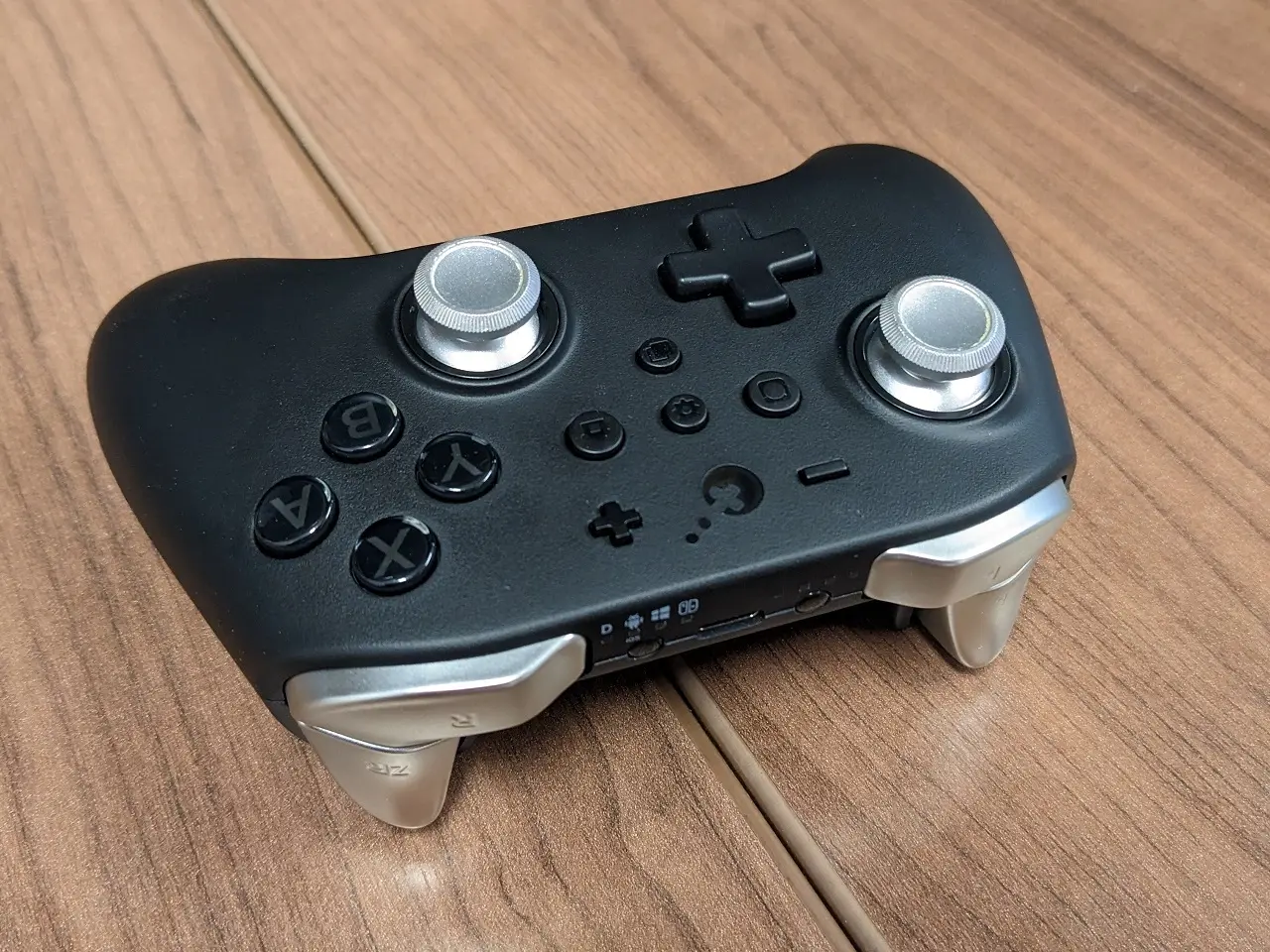
Update 2: I have received the controller and swapped the plastic thumbstick caps for silver aluminum ones. I think it looks pretty slick and it feels butter-smooth. The build quality is about 75% of the way there compared to a standard Xbox Core controller, but it still feels fairly solid and seems to be easy enough to repair. The unit is only held together by four phillips screws and some clips. I'll play some Vermintide 2 tonight and see how it performs. In the meantime, here are some pics of my controller.
My Zen Pro controller - Obverse
My Zen Pro controller - Reverse
2024 Update: After about seven months of use, the left thumbstick has started giving me trouble when sprinting in CoD (pressing forward on the thumbstick and clicking the L3 button at the same time). This failure is very common among OEM Xbox One Series X/S controllers, as well as original Xbone and DualShock controllers. I'll see about trying to repair it myself and if not, perhaps I'll invest in the next generation of Gulikit controller.
2025 Update: I have basically stopped using my Zen pro controller. It doesn't seem to be as sturdy as my Xbox Core controllers and the left trigger started failing alongside that thumbstick. When I do play games, I usually stick to the Core controller or a keyboard and mouse. I plan to keep using my Core controller until Microsoft produces one with hall-effect thumbsticks. I also haven't played games much in the last two years due to work and home life taking up more of my free time.
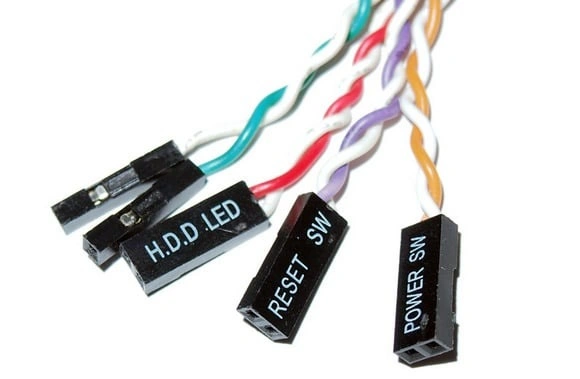
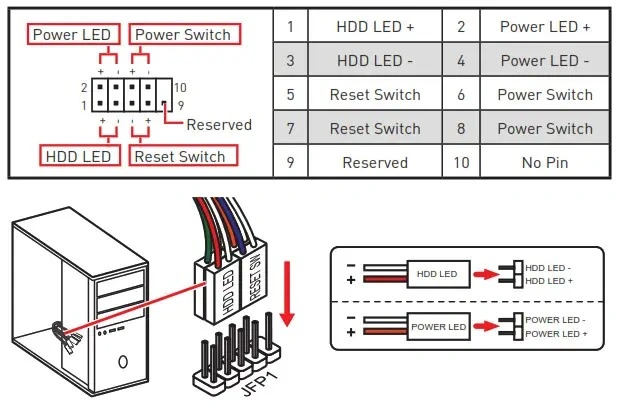
JFP1 (Jumper Front Panel 1) is the name for the header that connects a motherboard to the power switch, reset switch, Power LED, and HDD LED of the chassis. The cables can be quite annoying to connect in small cases and the motherboard doesn't always label them, so I find myself referring to a pinout diagram often, such as the example below.
JFP1 Pinout Diagram
I dislike the implementation of this connector and I think PC case manufacturers should start using a single connector instead of four or five separate cables.
These cables use "DuPont connectors" to interface with the chassis and motherboard and they seem to be used in a lot of electronics and hobby applications. As an experiment, I ordered a set of 2x5 DuPont connectors to see if I could accomplish this unification myself. Referencing a JFP pinout diagram, I removed the wires from the case's connectors, attached them all to the new DuPont connector, plugged it into a motherboard, and pressed the power switch.
It worked as expected and I now plan to outfit all of my desktop cases for the next century with this single connector. No more orientation guesswork, no more looking up "PC front panel pinout" or checking manuals. Some motherboard companies have tried to mitigate this problem by using labeled riser cards to make cabling easier, but my solution will permanently fix whatever case I apply it to.
Note: Since writing this section, I have applied these new DuPont connectors to half-a-dozen cases with great success. I will do it to all future cases I own.
Over the last month or so, my poor co-workers have been my captive audience for many hours of discussion and rambling about my desire to upgrade / rebuild / replace my NAS (Network Attached Storage) solution at my house. Currently, I have three NASs: a Synology DS216j, a Synology DS418, and a homemade AMD Ryzen based system in my Fractal Design Define 7 case.
Synology DS216j NAS
The DS216j was my first NAS purchased in the mid-late 2010s. Before this I primarily used an array of external hard drives, flash drives, and whatever else I could scrounge up to keep my stuff relatively straight and findable. With the DS216, I purchased two 4 TB Seagate IronWolf NAS hard drives for around $130 a pop. The 4 TB of usable space the RAID 1 setup provided was incredible and I quickly made use of this newly available digital real estate.
Synology DS418 NAS
About two years after that, I got my first IT job and began to make some real money ($7.80 an hour), allowing me to buy NAS No. 2. Around 2019, my DS418 made its way into my home and into my heart. I backed up the DS216j, removed the RAID 1 array, formatted both drives, and slapped them into my new four bay enclosure. I picked up two more Seagate 4 TB drives (for around $115 each) and completed my first RAID 5 array. Now with 12 TB of usable space.
Four years later and the time has come for me to upgrade once more. I actually purchased a new set of four 8 TB IronWolf drives ($160 a piece this time) around six months ago, even going so far as to build my own NAS out of spare parts and some Unbuffered ECC DDR4 that I picked up on eBay. This system seemed to work well, but in the Define 7 case, it was just too unwieldy and cumbersome to implement in my small house.
I almost took the lazy route of cutting my losses and buying a QNAP TS-462 enclosure and calling it a day. But this unit is (at the time of writing, $470). This is too much for my tight budget so I decided to stick to the DIY path and build one on my own. This venture will require a bit of planning and some thrifty shopping, spanning a few different online retailers and continents.
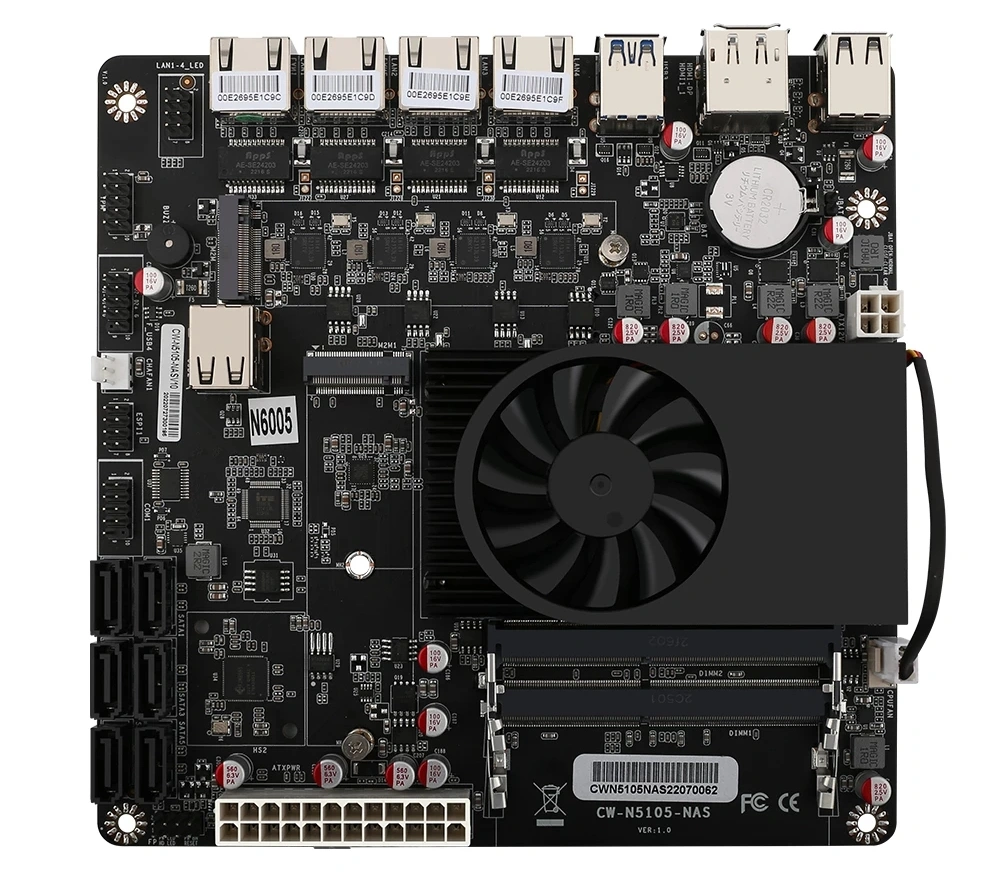
CW-N5105-NAS Motherboard
Firstly, I need a motherboard. Something with an SOC and at least four SATA ports, a NIC, and preferably in an ITX form factor. I decided to go with an off-brand Intel Pentium SOC board similar to the unit pictures and that NASCompares brought to my attention in this video. The unit I went with was about $130 on AliExpress.
This MOBO has six SATA ports, four 2.5G NICs, two DDR4 SO-DIMM slots, and two M.2 NVMe slots. This should be way more I/O and connections than I need for my setup, but I'll take it and consider it room to grow into.
Unbranded 4-Bay NAS Enclosure
Secondly, I need an enclosure. My Define 7 is a great case, sturdy, and with more 3.5" bays than I can afford to fill, but it's very heavy and imposing for the small amount of components I planned to stuff into it. The perfect case for my needs would be rather small and closer to the form factor of a standard 4-Bay NAS, preferably with four or more 3.5" hot-swap bays, support for a standard Mini ITX board, and cost less than $100 (I'm not made of money).
I found the above no-name case that really fit the bill and for around $80 new on Amazon. Along with that case, I grabbed a Noctua 80mm case fan to replace the stock exhaust and four left-angle (?) SATA cables to better suit this chassis.
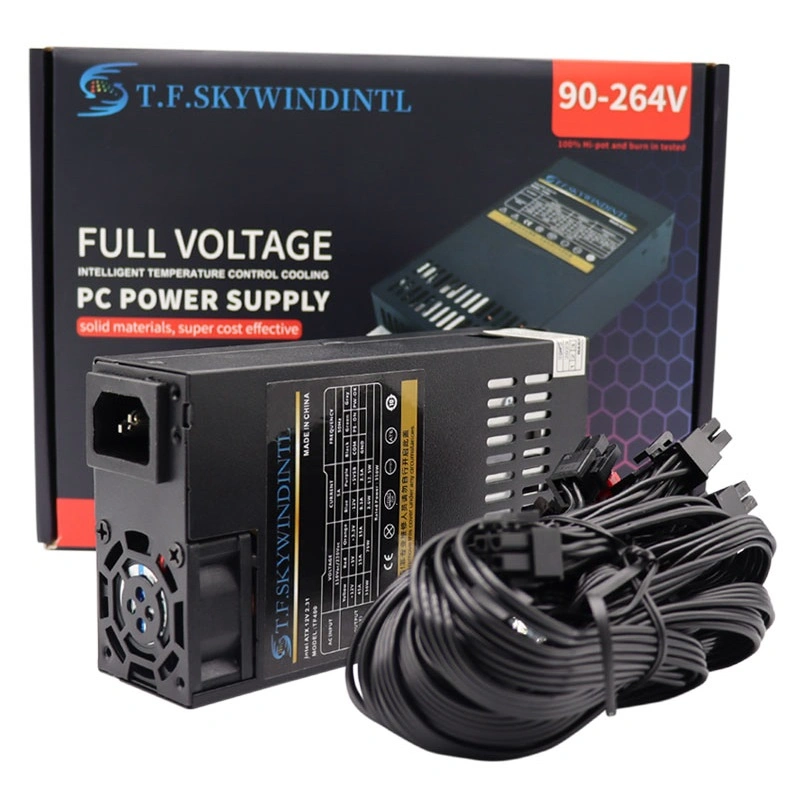
T.F. SkywindIntl Flex ATX PSU
Thirdly, I need a Flex ATX / 1U power supply. This is turning out to be the most difficult component to obtain, at least for a reasonable price. Silverstone has a reputable unit, but I can't justify spending another hundred dollars on yet another PSU to add to my collection. With a reputable brand out of the question, I'll resort to a less-reputable source to obtain a PSU. With slim options, I'm leaning away from the cheap Apevia unit that is usually at the top of search results and toward some even less well-known brand named T.F. Skywindintl that I found on AliExpress, Amazon, and eBay.
The unit pictured seems to cover all my bases and (assuming it doesn't blow up) should serve this build well. I'll probably go with this unit on eBay for around $50, the 60-day return window offered by the seller is a plus too.
Once all these components come in, I may make a follow-up post that details any weird aspects of the build that may materialize.
Topton NAS N1
2024 Update: I sold both of the Synology NAS enclosures to a coworker, bought and assembled all of the parts I specified above for a custom NAS, and even purchased another NAS enclosure, the latest one being a Topton NAS N1 (shown above). This Topton NAS is fairly cheap and often sold as a white label enclosure through various different brands on sites like AliExpress (where I got mine). It has an AMD APU, 2x DDR3 SO-DIMM slots, 2x NVMe M.2 slots, and 2x 3.5" HDD bays. I replaced the generic fan with a Noctua branded one, but I had to zip-tie it on as the fan screws weren't compatible with it.
The custom NAS has been working well, it's pretty quiet, and was fairly easy to build. I started off the project with four 8TB Seagate Iron Wolf drives, one of which died right away and I sent it off in July to be RMA'd (six months later and I have still not received this drive back). I set this NAS aside until around October, then I spent a good chunk of change on four 16TB WD UltraStar drives. These drives in a RAIDZ2 gave me about three-dozen Terabytes of storage which should last me quite a while.
Currently, I'm using just these latest two NASs for storage; The Topton NAS N1 for media and a Jellyfin server and the custom NAS as general storage and backups.
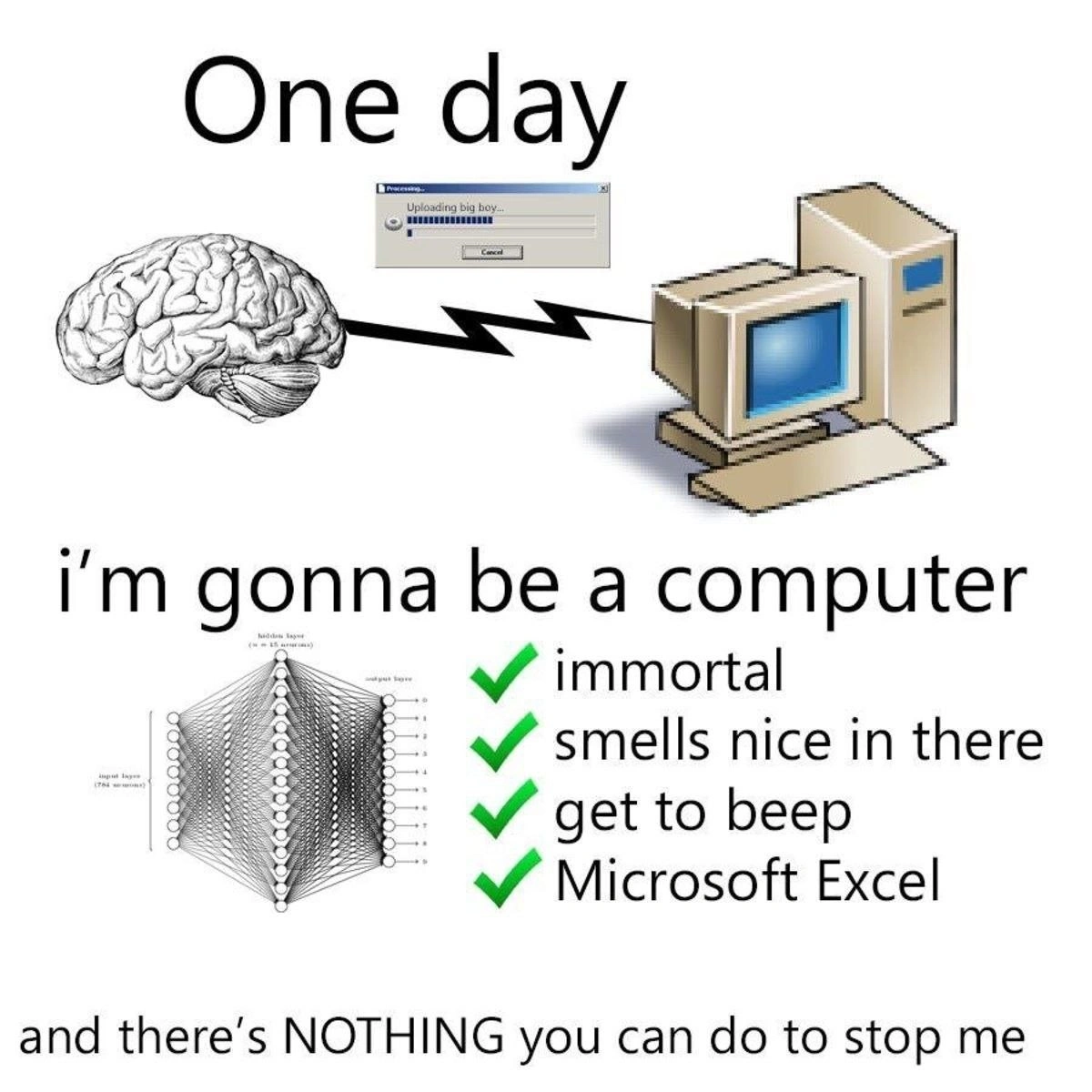
Assuming that life doesn't get inexplicably better before I'm old, I plan to retire my body (when the tech has arrived) and my consciousness into the silicon (or other future material) world.
I'm not terribly concerned about the cosmic, "SOMA" questions about whether you could actually move or merely copy a consciousness into a digital medium. Humans don't know what a consciousness really is or what happens after death and I sincerely doubt that will change in sixty years. I'll take my chances with the cybergods (and I'll be one of them soon enough).
So while you meatbags are rotting in the ground, I'll be in cyberspace; surfing the net, playing Minecraft, and reading all the books that I can cram into my flash chips.
Assuming I don't get murdered, imprisoned, or wheeled into the county morgue by any other untimely means that is.
I grew up in a rural part of the US in the early 2000s. I didn't have much in the way of technology for most of my younger years. At the age of eight or so, my family got a Dell Inspiron 530S for my siblings and I to play on. We still didn't have much in the way of internet however, most of the time on the computer was spent playing old PC games (Zoo Tycoon was the family favorite). My Dad's blackberry was used as a tethered hotspot for the family desktop for quite a while. Eventually, we upgraded to a 3G hotspot from Verizon with a 5 GB data limit each month. This was great as we could start to use the internet in a more stable and regular manner.
After using this desktop for a number of years and getting well acquainted with Windows Vista, my Dad noticed my growing computer proficiency. One day, around the age of eleven, he sat me down and said something like this:
"Son, you are more gifted with using a computer than I will ever be. I've worked with my hands all my life, but computers, they are the future. I want you to build your own computer, I'll help you buy the parts, but you've got to do the rest. I know you don't know much about how they work, but I want you to learn."
So I did. I spent many months reading, asking questions, and watching videos about how computers work, what they're made of, and why anyone would build their own computer when they could just buy one. Level1Techs, Linus Tech Tips, Bitwit, and The Tom's Hardware forum (just to name a few) were all tremendously helpful for someone who knew next to nothing about computers at ten but was able to build their very own desktop by age twelve.
That desktop did not last forever, as no computer will, and after a number of years of service, there had been an issue with the power supply that led to the death of the machine. Looking back, it was probably easily fixable, but no matter. The desktop was given to me to take care of and I disassembled it for what parts I could take. The 120 GB hard drive (iirc), the few gigs of DDR2, CPU, and Motherboard all made their way out of the device and into my possession.
I held on to the chassis as well, but as I learned more about computers, I realized that this chassis didn't have a removable I/O shield. In its stead was a fixed plate, for only the original motherboard. This wouldn't do, so I cut out the plate with some tools and I was eventually able to fit an aftermarket motherboard in that case. Later, I realized what a terrible cut job I had made, so I trashed the whole thing and moved on.
After doing months of research and a lot of reading on the matter, I was confident that I could pick the correct parts to build a functional computer. My Dad and I sat down, we navigated Amazon and eBay and Newegg, eventually settling on a selection of parts. Most notably, an MSI GeForce GTS 450 graphics card. This card was terrible, even for the time. But it was inexpensive and was compatible with the parts I had. Some of the needed parts (a chassis, power supply, and disk drive) I had on hand from an old PC that my Dad's boss donated to my project.
A few weeks later (before the time of 2-Day shipping) my parts had arrived and I got to work. With the new GPU installed, my desktop idled on my Windows Vista desktop in crisp 1680×1050. As a bit of incentive when I was planning my computer, a friend of mine gave me his old copy of Fallout 3 to play once my new PC was assembled. I quickly installed it and fired it up to test my new digs. The green haze of the Capitol Wasteland glowed brightly on my shining face.
I wholly enjoyed the experience of building, installing, and playing a game on my new-ish PC, but the machine was slow, loud, and I'm pretty sure I didn't make sure my PSU had a high enough wattage rating to support playing a game. I knew I needed to upgrade parts eventually, but my Dad wasn't an ATM, so every computer I've built or bought since has been funded solely by myself. I also knew I needed to build something better, with new and current parts, and build I did.
By high school, I had built several computers, I became the go-to "IT Guy" in my class, and I assisted a lot of teachers and students with their computer questions and problems. I even built a few desktops for my teachers, taking a small profit of course.